
Science Finally Caught Up to the Way You Actually Live
Because aging well isn't about doing it perfectly. It's about continuing to show up.

I’ve long espoused and lived by the philosophy that “something is better than nothing” when it comes to movement and exercise. Anything that gets our blood flowing and gets us off the couch is better than not moving at all.
But my something is better than nothing movement philosophy wasn’t reflected in the exercise guidelines. Not, that is, until this year.
The organization that has officially adopted my philosophy? The American College of Sports Medicine (ACSM)—the globally recognized gold standard in exercise science. ACSM exercise physiologists, sports medicine physicians, researchers, public health specialists, and athletic trainers have long translated research into guidelines that shape clinical practice, public health policy, and yes, personal trainer certifications.
I know because I hold one. When ACSM speaks, the fitness and medical world listens. So when they published a landmark update to their resistance training guidelines this year—their first in 17 years, synthesizing 137 systematic studies—health and wellness professionals took notice. And I breathed a sigh of relief and said, “It’s about time.”
To be precise: what ACSM overhauled was specifically their strength training prescription. But it signals something much bigger—a philosophical shift in how exercise science thinks about the relationship between perfect programs and real participation. And that shift has been building across the entire movement-and-mortality research landscape for years.
As an ACSM-certified personal trainer, I've taught the guidelines for over 20 years. I believe in them and try to adhere to them. But I also live in the real world. There have been plenty of weeks when my second strength workout didn't happen. Instead, I’ve squeezed in a few sets of sit-to-stands, done a few sets of counter push-up’s, or did step-up’s on a park bench during a walk. Under the previous guidelines, that fell short. The new guidelines recognize that it still counts.
ACSM’s revision is nothing short of remarkable. It now officially recognizes what many of us knew to be true all along: the perfect program that nobody actually does is infinitely worse than the imperfect one somebody shows up for.
Science, meet real life.
The Prescription That Was Making Us Sick (Of Trying)
For decades, if you wanted to know the “right” way to exercise, the ACSM had a very specific answer. One hundred and fifty minutes of moderate aerobic activity per week. Strength training at least twice a week with specific intensities, set counts, and rest intervals.
For many it read less like health guidance and more like a job description. And too many people just threw up their hands and decided not to apply.
The previous guidelines had a problem that nobody talked about: they weren’t designed for humans living human lives. They were designed to produce the best measurable outcomes in controlled research settings with motivated participants, supervised sessions, and zero competing demands from a busy life.
The reason isn’t that we’re lazy. It’s because the bar was set in a laboratory, not a life.
The result? Over 80% of the general population consistently failed to meet those guidelines. National survey data show that only about 1 in 5 U.S. adults age 65+ performs strength training at least twice per week—the minimum recommended to maintain muscle and function as we age. Only 13.9% of us meet both aerobic and strength components.
For active agers specifically, that failure rate carried an extra sting. There’s already a psychological weight that comes with watching your body change—the gap between what you used to do and what you can do now is emotionally loaded territory.
Add a checklist you can’t complete, and you’ve created the perfect conditions for the most dangerous thing in aging well: giving up entirely.
The Permission Slip the Research Was Trying To Give You

What’s extraordinary isn’t just that the guidelines changed. It’s what the underlying research had been telling us for years, if anyone had been listening.
Studies examining the dose-response relationship between physical activity and mortality found something that should be shouted from every gym, doctor’s office, and community center in America: there is no minimum dose of physical activity required for life-prolonging benefit. Any movement is better than none.
More striking still is that the largest difference in mortality rates doesn’t exist between the casual mover and the dedicated athlete. It exists between the person who does nothing and the person who does something. Even something small.
A large cohort study of older adults found that engaging in any amount of weight training was associated with a 6% lower risk of all-cause mortality, an 8% lower risk of cardiovascular disease mortality, and a 5% lower risk of cancer mortality—compared with those who did none. Not compared to people doing 3 sets of 10 with perfect progressive overload. Compared to doing nothing.
The new ACSM guidelines are finally saying out loud what the data has been whispering: consistency beats complexity. Doing something beats doing nothing.
“The best resistance training program is one you will actually do.”
American College of Sports Medicine
The key findings in the ACSM resistance training guidelines updates are the permission slip we needed to create a resistance training program that works for us. The updated guidelines still emphasize training all major muscle groups at least twice a week. What's changed is the emphasis. The focus is no longer on finding the perfect prescription. It's on finding a form of resistance training you'll actually do consistently. Bands. Bodyweight. Machines. Dumbbells. Home workouts. Gym workouts. The best program is the one that becomes part of your life.
The new guidelines recognize that every step forward matters. And among all forms of exercise, resistance training may be one of the most powerful tools we have for maintaining independence, metabolic health, and quality of life as we age.
What Took Them So Long?
The science supporting “something is better than nothing” has been accumulating for years. Researchers studying physical activity and mortality have long documented what they call a non-linear dose-response curve—meaning the benefits of movement are steep and immediate at the low end, and flatten out at the high end. You gain an enormous amount by going from nothing to a little. You gain incrementally less by going from a lot to more.
Active agers figured this out intuitively. The people in your neighborhood walking every morning knew it. The older adults who kept moving in whatever form suited their body and their life were living their lives ahead of the research curve.
The guidelines are catching up to the wisdom that was already in the field.
The Perfectionism Trap in Aging (And Why It’s Especially Dangerous)
There’s a specific flavor of perfectionism that shows up in active aging, and it’s worth mentioning.
It often sounds like this: “If I can’t do what I used to do, why bother?” Or: “I tried a program but I couldn’t stick to the schedule, so I stopped.” Or even: “I only have 15 minutes. That doesn’t really count.”
The all-or-nothing thinking that derails healthy habits at any age hits harder in the context of aging, because the gap between our peak physical selves and our current ones can feel like loss. Every shortfall against an ambitious guideline can feel like confirmation of decline rather than a simple reality of a busy life.
The new ACSM resistance training update is a clinical repudiation of that thinking — and the broader movement science backs it up. The message, structurally and officially: the band workout in your living room counts. The two sets instead of three counts. The body weight exercise counts.
What doesn’t count is waiting until you have the perfect program or a gym membership.
So What Does This Mean for You, Practically?
The shift from prescriptive to realistic doesn’t mean “anything goes.” It means the entry point just got lower, and the science backs that up.
A few things worth holding onto:
Start where you are, not where you were. The research is clear that the most powerful move you can make is going from sedentary to any movement. If you’ve been inactive, sitting down and standing up from your chair a few times a day isn’t a consolation prize. It is, according to the data, one of the most significant health decisions you can make.
The best exercise is the one you’ll actually do. The new ACSM guidelines explicitly state that regular participation in a routine a person enjoys is the best predictor of long-term adherence. Enjoyment is no longer the soft, unscientific reason you chose yoga over the gym. It’s now the clinical recommendation.
Strength training is non-negotiable—but the bar is lower than you think. Muscle mass is one of the most powerful predictors of longevity and independence as we age. But the new guidelines confirm that the biggest gains come from going from zero to any resistance training—not from following a complex periodization program. Bands, bodyweight, light weights. Twice a week. That’s the threshold.
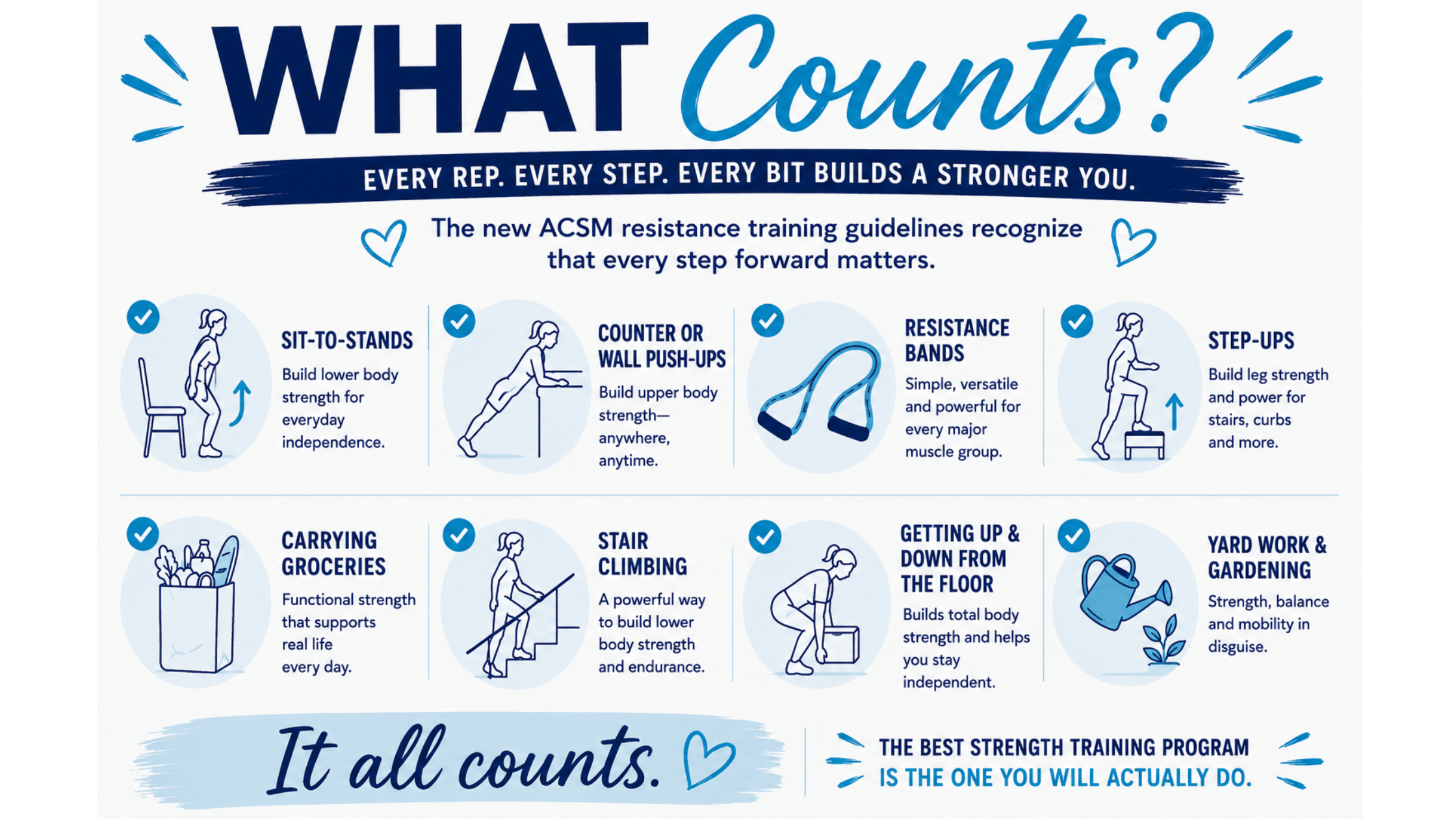
Every sit-to-stand, band exercise, wall push-up, and step-up is an investment in the muscle that helps you carry groceries, climb stairs, get off the floor, and remain independent. Movement isn't just about burning calories or improving fitness scores. It's about preserving the physical capacity to live life on your own terms.
The benefit doesn’t have an expiration date. Research confirms that the mortality benefits of strength and aerobic activity hold for adults aged 85 and older. There is no age at which it stops mattering. There is no point at which it’s too late to start.
What “Something” Might Look Like
If you’re wondering whether your version of resistance training counts, it probably does.
Sit-to-stand’s when you get up to go to the bathroom.
A few counter push-up’s while waiting for the microwave.
A short resistance-band routine at your desk or while watching TV.
Carrying groceries to and from the car.
Taking the stairs.
Getting up and down from the floor.
Step-up’s on stair or curb.
None of these activities will make the cover of a fitness magazine. But every one of them counts.
The Deeper Shift
What ACSM did in 2026 was more than update a set of numbers. They acknowledged something that active agers have always known: that health is lived in real circumstances, not ideal ones. That a body that keeps moving—imperfectly, inconsistently, in whatever way it can—is doing exactly enough.
For fifty years the guidelines spoke the language of optimization. Now they’re learning to speak the language of sustainability.
The ACSM hasn’t lowered the bar. It’s finally built the bar that more people can actually reach, grab onto, and hold.
You were right to keep moving in whatever ways you could. And if those movements helped you build and maintain muscle along the way, you were doing even more for your future than you may have realized.
What strength-building habit can you do more consistently with perfection off the table?
Unloading and stacking 3/4 ton of hay counts then! The very reason I don't do a set of resistant band exercises is that I need all of my energy to do the farm chores. But I still managed to feel guilty about that. So thank you.
Thank you for this encouragement — just when I need it as I develop a plan (rhythm) to move beyond my 8000+ daily steps and incorporate focused strength training to build and sustain muscle mass. Just yesterday I picked up a copy of Cody Sipe’s book “Quick Functional Exercises for Seniors”. I’m thankful to have “discovered” you here on Substack. Thanks for sharing your wisdom and expertise in this new season of your life.