
I'm Not Retiring: I'm Just Getting Started

After nearly 40 years as an attorney (hard to believe I’m even writing that number), I’m stepping away from the practice of law.
January 30th is my last day as a lawyer. Each day of this final week has been filled with anticipation and excitement. It’s finally here; it’s really happening!
You might think that I’d feel sadness or perhaps even loss at leaving behind a 40-year career. But I can honestly say that I have zero regrets.
It’s time for a change. I’m ready to close this chapter and write a new one.
I don’t plan on having a stereotypical retirement. No grass will be growing under my feet if I can help it. I’m celebrating the end of a successful career, and the beginning of an exciting and exhilarating future.
How I Got Here

I’ve been thinking about “retiring” for about eight years, seriously planning for and imagining what comes next. My goal was to retire at 62.
Year end 2023, I wrote my resignation letter, giving 60-day’s notice. But it didn’t feel right. My first clue that maybe I should wait was when I cried reading my short resignation letter out loud. I was also concerned about pesky things like health insurance coverage for the 3 years until Medicare would kick in. So I decided to trust my gut and stay for just one more year.
I gave my firm a year’s notice that I’d be leaving December 2024. My countdown had officially begun. Late in the year they asked if I’d stay through the end of 2025. I agreed, but only on my terms with the understanding that I’d be leaving at year end.
So what happened? Well they implored me to stay through January 2026. I reluctantly agreed to a one-month, absolutely final extension that carried a non-negotiable deadline of January 30th.
And here I am at last! Ready for new adventures and experiences. No regrets, and no second thoughts.
I’m proud of my career as a lawyer. I gave it my all, and I mostly enjoyed it. I’ve certainly had many memorable experiences. I’ve met amazing people—clients, students, and colleagues. I’ve handled difficult cases and large transactions. I received recognition and accolades from my peers, and recognized and respected attorney ranking organizations. I had a beautiful career—everything from public interest work to teaching, to owning my own firm, and finally over 20 years at my current firm.
But it’s time for a new beginning. When you know, you know.
Why I Chose Law—And Why I’m Now Choosing Something Else
I didn’t stumble into law. I chose it for the same reason I’m now choosing the path of health and wellness coaching and health education: I want to help people have better lives.
For years, practicing law lit me up. I was good at it. It was challenge and a rush.
But after 40 years I’ve lost the fire for it. Law can be all-consuming and stressful in ways that began to drain me rather than energize me. So instead of trying to soldier on, I listened to myself with compassion. I realized that I needed and wanted something different at this point in my life.
I’m not running away from a career that I was good at. I’m walking toward something that lights me up the way that practicing law used to. By my definition that’s growth, and the ultimate form of self-care.
I’m not retiring from something: I’m retiring to something—helping people add life to their years by achieving their best lives and living them fully until their story is complete.
Health and wellness and movement and exercise have long been a passion of mine. I got certified as a personal trainer by the American College of Sports Medicine over 20 years ago, and I’ve taught group exercise classes for longer than that. But the time pressures and schedule of a busy lawyer didn’t allow much time for personal training and fitness classes. And oh, how I missed it.
So when I decided that I wanted to take the path to become a health and wellness coach, I went back to school and took the exam to become a nationally board certified health and wellness coach (NBC-HWC). That knowledge and credential, together with my ACSM personal trainer certification, and my certification as a Senior Fitness Specialist, gave me the foundation and credibility to build this new and different life.
I’m building something new. Something that brings me joy and allows me to help people, while giving me the time and flexibility to enjoy my friends and family, and to travel and hike with my husband. This is the purposeful and well-rounded life of my “retirement.” This is my definition of what “success” looks like now.
My “Ah-Ha” Moment
There was a moment, years into my legal career, when I looked at my life and realized something that scared me: all I really knew how to do was work. My career was so all-consuming that I didn’t have time for anything else. My personal life and social connections centered around what I did. I didn’t know what to do when I wasn’t working.
That realization shook me. I started making changes then, but it’s hard with a demanding career. The momentum of a profession like law—or medicine, academia, any high-identity career—has tremendous gravity. It pulls you in. It becomes not just what you do, but who you are.
The Identity Question: Lessons from My Mom
I saw this play out with my Mom when she retired from teaching. It was her identity, and she struggled. Teaching wasn’t just her job—it was who she was.
My sister, also a teacher, became Mom’s lifeline when she made Mom her teaching “assistant.” It gave her a place to go, people to be around, and perhaps most importantly, it allowed her to maintain her identity as a teacher. That, coupled with tutoring, wasn’t just something to fill time: it was a bridge that allowed her to carry forward the parts of herself she valued most.
Not everyone experiences retirement this way, but for those of us whose careers have been deeply woven into our identities, the transition requires intentional thought and planning. The research backs this up: retirees who were strongly tied to their work roles are more prone to experience diminished mental well-being after retiring. In fact, approximately 28% of retirees experience depression—substantially higher than in the overall older adult population.
The loss may be more about the extent to which we identify ourselves with our profession rather than work itself. As one retirement researcher put it: retirement involves a discontinuous loss of job-related identity. When you’ve spent decades answering “What do you do?” with your profession, suddenly having no ready answer can feel disorienting.
Why Purpose Matters
When I started planning this transition eight years ago, I wasn’t just thinking about leaving law: I was thinking about what comes next. Because what I’ve learned from research and from watching people around me is that retirement without purpose is risky business.
I watched my Mom struggle with this. I’ve seen colleagues flounder. And the science backs up what I’ve observed: having a sense of purpose in life affects how long we live and how well we age.
When I first saw the numbers they stopped me in my tracks. People with a strong sense of purpose have about half the mortality risk of those without it—comparable to not smoking or exercising regularly. And these benefits held true even after researchers controlled for depression, physical health, and lifestyle behaviors.
Purpose has an independent effect on longevity. But even more importantly, purpose is an essential component of Wellgevity (Wellness + Longevity).
Why does this matter to me? Because I don’t want to just add years to my life: I want to add life to my years. I don’t want to drift aimlessly. And I don’t want to wake up a year from now wondering what happened to my days. I want to wake up every day to something that lights me up and keeps me engaged with life.
That’s why I’m not just retiring from law, I’m retiring to something else: health and wellness coaching and a business and a life that are within my control. I’m designing and aligning my future on my terms. I’m building something new that’s mine. Not because I have to, but because I want to.
Living life with joy and purpose and having a reason to get up in the morning is non-negotiable. It’s the kind of life I intend to live as long as I live.
Connection: Another Non-Negotiable
During that moment when I realized that all I knew how to do was work, I also realized something else: most of my social connections revolved around my job. I had few outside friends.
That was a sobering thought, which was almost as scary as being so consumed with my career that I had difficulty knowing what to do when I did have free time.
The Harvard Study of Adult Development—now in its 85th year—has tracked people across their entire adult lives, and the director puts it plainly: “Strong social relationships are the most consistent predictor of a long life.”
Adults 60 and older who stay socially engaged—through volunteering, clubs, family time—have a 42% lower risk of death than those who don’t. And it’s more than just being around people. It’s meaningful, reciprocal connection that makes the difference. This is the kind of connection where you’re known (think Cheers where everybody knows your name) and you matter.
Even though scrolling on my computer, watching TV, and reading can be pleasant in limited doses, they tend to be solitary activities with minimal or limited engagement. I love to read and could easily spend most of my time reading. I could happily disappear into books and online rabbit holes. But I know that would get old after a while, and I also know it wouldn’t be enough. We need human interaction.
That’s why my vision for this next chapter of my life includes both work that connects me to people and time deliberately spent with friends and family. Hiking with my husband at national parks across the country (thank you Heather Hausenblas, PhD for this inspiration). Outings and sharing meals with friends. My coaching work will be both in-person and online because both matter. While online gives me reach and flexibility, in-person gives me the kind of connection that feeds my soul.
I’m not leaving all my social connections behind when I leave law. But I am being intentional about building new connections and deepening existing ones outside of work, because isolation as we get older takes a toll on our health and well-being. One in four adults 65+ is socially isolated, and the health risks rival those of smoking.
I want better for myself. And I want better for you.
Purpose and connection are twin pillars of aging well. But what if you know connection matters but don't know what your purpose is?
What’s Your Purpose?
I’m fortunate because I’ve known for years that I wanted to move into health and wellness coaching for older adults. But I know that’s not everyone’s story. Maybe you’re reading this thinking, “That’s great for you, but I have no idea what I’d do.”
But your purpose doesn’t have to look like mine. It doesn’t have to be starting a business or building career 2.0. It doesn’t even have to be “productive” in the traditional sense.
Maybe your passion is a lighter version of your career identity. My Mom couldn’t let go of teaching completely, so she tutored and became my sister’s assistant. Maybe you consult occasionally in your field, or maybe you mentor. Perhaps you take what you loved about your career and find a way to keep that part without the stress.
Or maybe, like me, your purpose has nothing to do with what you did for 40 years. Maybe it’s art classes. Maybe it’s joining a hiking group where you get exercise AND connection. Maybe it’s volunteering for a cause that warms your heart. Maybe it’s being the grandparent who’s present and takes time.
The important thing is it brings you joy and lights YOU up. It’s something that brings you fulfillment and joy and makes you want to get out of bed.
And if you don’t know what that is yet? That’s okay. Experiment; and try things. There’s no right or wrong answer. You don’t have to get it on the first try. We’ve got time and wisdom on our side. And the best part? You get to choose what you want and what it looks like on your terms.
The key is not drifting. Not letting days turn into weeks turn into months of nothing. Because that’s when the research on isolation and depression becomes personal rather than academic. That’s when you wake up and realize you’re at sea and you don’t know how you got here.
What I Wish Someone Had Told Me
“But what if I’m scared?”
Then you’re paying attention. Every major life transition comes with fear. I’ve been planning this for eight years, and even though I built a long runway, I still have moments of “What am I doing?” That’s normal. The question to ask yourself is whether you’re willing to move forward anyway. Fear and excitement often feel identical in the body. Maybe you’re feeling a little of both.
“What about the practical stuff—health insurance, finances, all of that?”
This is real. And it’s one of the things that held me back. The practical considerations matter and must be addressed. For me that meant staying longer to get certain benefits in place. For you it might mean something different. Don’t let practical concerns become an excuse for never making the leap, but also don’t be reckless. Get your ducks in a row. Talk to a financial advisor. Make a plan. Execute it.
“I’m worried I’ll be bored.”
If you’re worried about being bored, you probably won’t be. Boredom happens when you’re drifting, not when you’re intentional. The people who struggle most in retirement are those who haven’t thought about what comes next. You’re reading this, which means you’re probably thinking about it. That puts you ahead of the curve. Make a list of 20 things you’re curious about or want to try. You don’t have to do them all. You just have to start.
“What if I miss my work identity more than I expect?”
You might. My Mom did. Some of my colleagues have. If that happens, you adapt. Maybe you find ways to keep a foot in that world—consulting, mentoring, volunteering in related areas. Maybe you discover that what you miss isn’t the work itself but the structure, the connection, the sense of contributing, and you find new ways to meet those needs. Identity is fluid. You’re allowed to adjust.
“Is it selfish to prioritize my own fulfillment now?”
No! Taking care of yourself by building a life that brings you joy and purpose isn’t selfish. You’ve spent decades contributing, working, helping others. This next chapter is yours. And frankly, you’ll be a better spouse, parent, grandparent, friend when you’re fulfilled than if you’re dissatisfied with your life. Don’t let guilt keep you stuck.
Building Something New (Even When It’s Scary)
Here’s something I haven’t talked about much: I’m building a business. It’s challenging in a good way.
I’m learning how to build a website. How to create online courses. How to facilitate group coaching. I’m figuring out technology that sometimes often makes me want to throw my computer across the room. I’m putting myself out there in ways that feel vulnerable and uncomfortable.
And I love it!
Not because it’s easy—it’s not. Not because I’m naturally good at all of this—I’m not. But because I’m choosing what I want to spend my energy on now.
I have no intention of making this a full-time, nose-to-the-grindstone career with all the stress and all-consuming intensity of practicing law. I’m pursuing a passion that allows me to continue living my life. Helping others while leaving time and energy for what matters most to me.
This is me adding life to my years!
The research is clear: retirement done right—with purpose, challenge, and connection—extends lifespan and compresses the period of illness at the end of life. We can be vital, engaged, contributing members of our communities until we complete our last chapter.
But it doesn’t happen automatically. It requires a leap of faith and the courage to step into uncertainty and build something new, even when (like me) you’re not sure you can figure out the technology or whether anyone will care about what you have to offer.
We can always find reasons why we “can’t” or “shouldn’t.” But take a minute to envision what your life would and could be if you decided to believe in yourself and pursue your dreams—whatever they may be.
If you read this on Friday, I’ll be just hours away from ending this chapter and starting a new one. And I’m ready!
Because we don’t age well sitting still. We age well when we move forward with purpose, staying connected to the people who matter, and continue to grow until our story is complete.
That’s not retirement. That’s living.
The Queen Of Flourishing
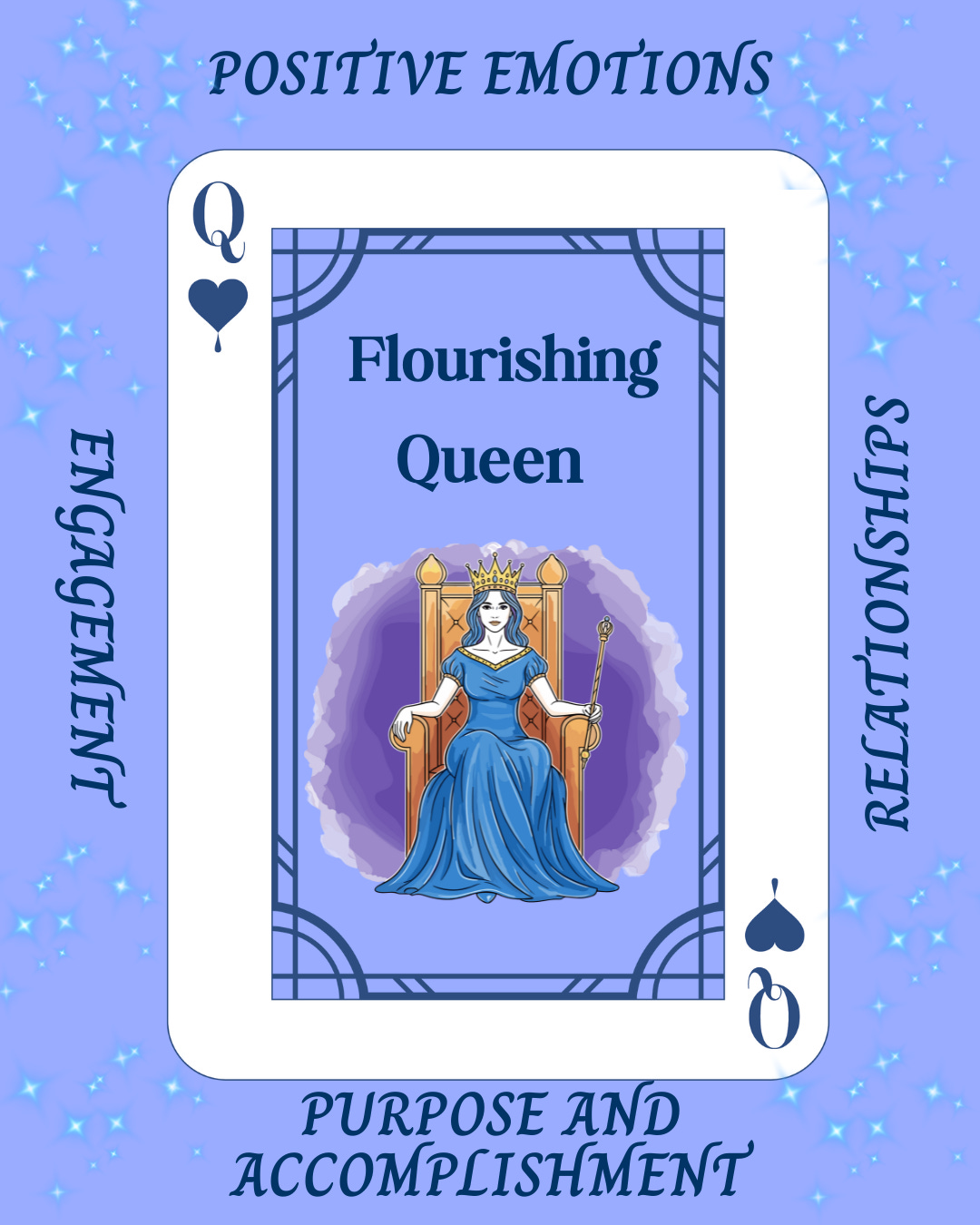
My word for 2026 is “flourishing.”
I even created a visual—a playing card (inspired by Georgina Dean): The Queen of Flourishing. Because that's what this next chapter is about. Flourishing!
Flourishing means thriving, growing, blooming. It’s the opposite of floundering or drifting—the very things I watched others struggle with and was determined to avoid.
My invitation to you: Don’t just retire. Flourish!
Here’s to new beginnings. Here’s to all of us who have the courage to shed our old skins and step into what lights us up. Here’s to adding life to our years!
This is my retirement party. And you’re all invited.
Cheers,

Now it’s your turn. What chapter are you ready to close? What new book are you ready to start writing? Drop a comment below or send me a message—I’d love to hear where you are in your own journey. And if you’re thinking about making a big transition but don’t know where to start, let’s talk.
Research Citations
Hill, P. L., & Turiano, N. A. (2014). Purpose in life as a predictor of mortality across adulthood. Psychological Science, 25(7), 1482-1486. https://pubmed.ncbi.nlm.nih.gov/24815612/
Boyle, P. A., Barnes, L. L., Buchman, A. S., & Bennett, D. A. (2009). Purpose in life is associated with mortality among community-dwelling older persons. Psychosomatic Medicine, 71(5), 574-579. https://pmc.ncbi.nlm.nih.gov/articles/PMC2740716/
Kim, E. S., et al. (2022). Purpose in life and reduced risk of mortality and chronic conditions. Preventive Medicine, 149, 106598. Research cited in: https://www.psychologytoday.com/us/blog/beyond-longevity/202503/the-hidden-power-of-purpose-for-longevity-0
Martela, F., et al. (2024). Which predicts longevity better: Satisfaction with life or purpose in life? Midlife in the United States (MIDUS) Survey. https://midus.wisc.edu/findings/pdfs/2842.pdf
Yang, Y. C., et al. (2016). Social relationships and physiological determinants of longevity across the human life span. Proceedings of the National Academy of Sciences, 113(3), 578-583. https://pmc.ncbi.nlm.nih.gov/articles/PMC4725506/
Waldinger, R., & Harvard Study of Adult Development. Research cited in: https://www.accesscarepartners.org/the-impact-of-social-connections-on-longevity/
Kim, E. S., et al. (2020). The prospective association of social integration with life span and exceptional longevity in women. The Journals of Gerontology: Series B, 75(8), 1689-1700. https://pmc.ncbi.nlm.nih.gov/articles/PMC7664314/
Ong, A., et al. (2023). Social connectedness, functional capacity, and longevity: A focus on positive relations with others. Social Science & Medicine, 340, 116457. https://www.sciencedirect.com/science/article/abs/pii/S0277953623007761
Ong, A., Mann, F., & Kubzansky, L. (2025). A lifetime of social ties adds up to healthy aging. Cornell Chronicle. https://news.cornell.edu/stories/2025/09/lifetime-social-ties-adds-healthy-aging
National Institute on Aging. Social isolation, loneliness in older people pose health risks. https://www.nia.nih.gov/news/social-isolation-loneliness-older-people-pose-health-risks
Fadaeva, A., et al. (2024). Retirement adjustment framework: Understanding the interplay between individual and contextual factors. SAGE Journals. https://journals.sagepub.com/doi/10.1177/26320770241279737
Wang, M., & Shi, J. (2014). Psychological research on retirement. Annual Review of Psychology, 65, 209-233. Comprehensive review of retirement research cited in: https://www.kiplinger.com/retirement/how-to-overcome-identity-loss-in-retirement
Nebraska Medicine. (2024). Finding your identity after retirement. https://www.nebraskamed.com/health/healthy-lifestyle/geriatric-mental-health/finding-your-identity-after-retirement
Hey Daria,
Heather pointed me to your beautiful article.
It was great to get a view behind the curtain of your fulfilling first career, which was both satisfying and as you pointed out, also very consuming.
Your passion and experience in health coaching shines through in every piece you publish. I’m always enjoying how you casually combine scientific results with your own perspective and advice.
Purpose is such an important part in life. After 7 years in my role in health management, I’m in still grateful for the position i have, my colleagues and the freedom I enjoy, but I can hear the knocking on the door louder and louder that change is needed.
I wish this applies to the business in building, but it may as well involve another role in the corporate world.
I know we are connected here, which is pleasure. For now, I wish you a great start into…how should I call it, the new and exciting journey which now gets you full attention
Love how you frame this. Perfect and beautiful.