
What My Back-Up Camera Taught Me About Healthy Aging
Wellgevity Life Skills #4: Why twisting and turning may be one of the most important abilities you never think about—until they become harder.

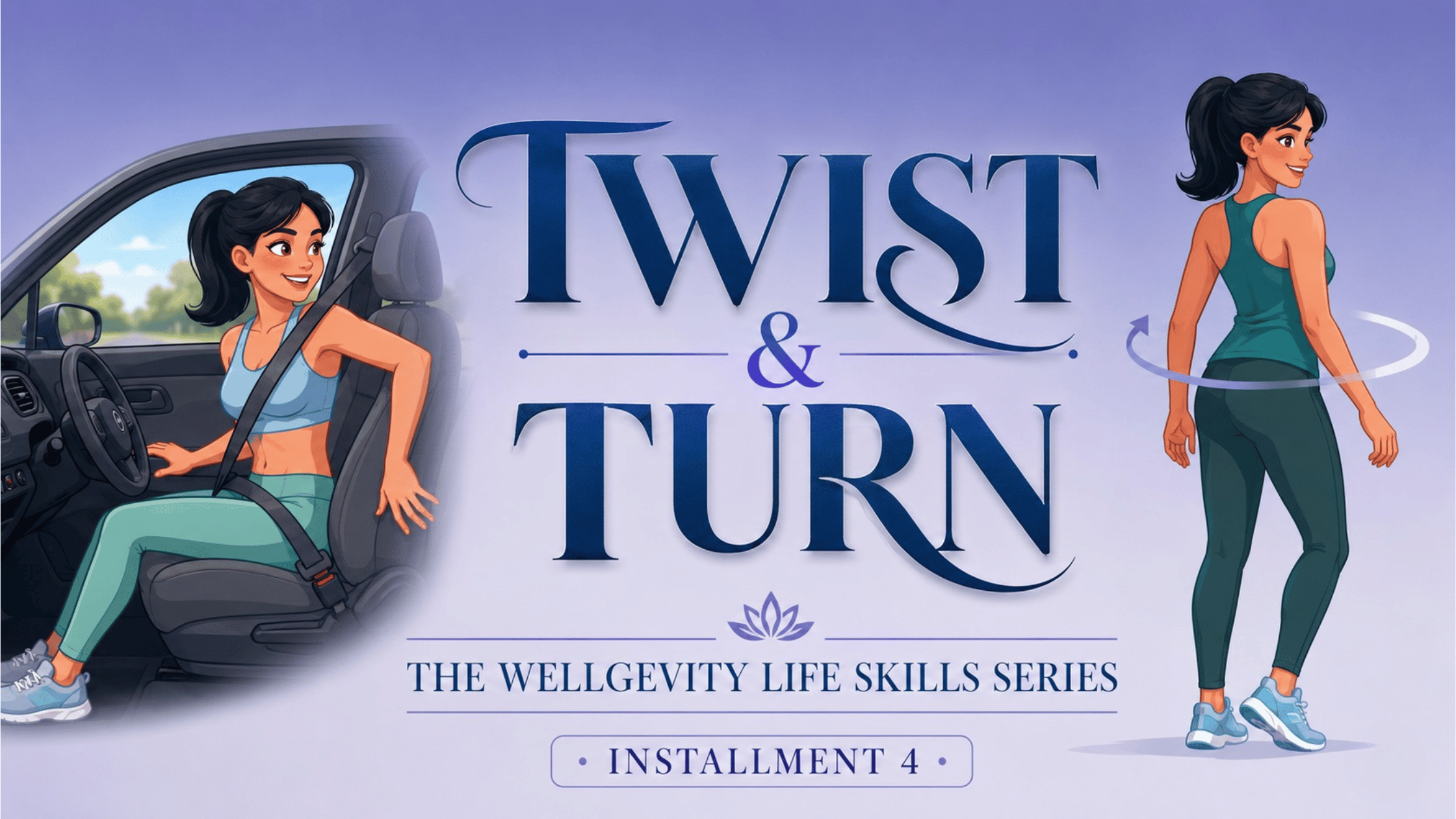
I know I’m in the minority, but I still turn and look behind me before backing out of a parking space.
Yes, my car has a backup camera that I use. The camera is a useful addition, but I haven't quite surrendered the habit of turning my head to see what's behind me.
Recently it occurred to me that backup cameras are just another example of how we’ve redesigned our environment to reduce human movement. We drive instead of walk. We use elevators instead of stairs. We use remote controls instead of getting up from the couch. And now, we back up our cars without ever turning our heads or rotating our bodies.
None of those technological changes is inherently bad. The challenge is that when movement is no longer required, we often do less of it, thereby eroding the very thing essential for continued mobility and independence.
Most of us don’t think much about rotation. We just do it... until it becomes uncomfortable. Yet, think about how many daily actions require some degree of rotational movement: looking over your shoulder, reaching into the back seat, turning to speak to someone, unloading groceries, making the bed, gardening, dancing, playing golf, or simply navigating a crowded room.
These are the everyday movements that depend on a physical skill that deserves far more attention than it typically receives.
The ability to twist and turn is a Wellgevity Life Skill.
We Live in a Three-Dimensional World
As I’ve been writing this article, I’ve started paying closer attention to how often I rotate during the course of a normal day.
I turn to unload the dishwasher and put plates into cabinets. I twist to reach something in the passenger seat. I rotate while making the bed, carrying groceries, and looking behind me when backing out of a parking space.
What surprised me wasn’t how often I rotate. It was realizing that my range of motion has decreased a bit.
But if I hadn't started paying attention, I might not have noticed it at all. While I can still do all of these things comfortably, if I’m being honest, I don’t turn quite as far or as easily as I once did. And that’s exactly why this matters.
I don’t want to wait until turning becomes difficult. My goal is to notice changes while I still have time to do something about them.
I’ve noticed it. And I’ve decided I’m going to do everything I can to maintain the rotational mobility I have and improve it where I can.
After all, the body tends to maintain the abilities we use regularly, and twisting and turning is an ability I intend to keep.
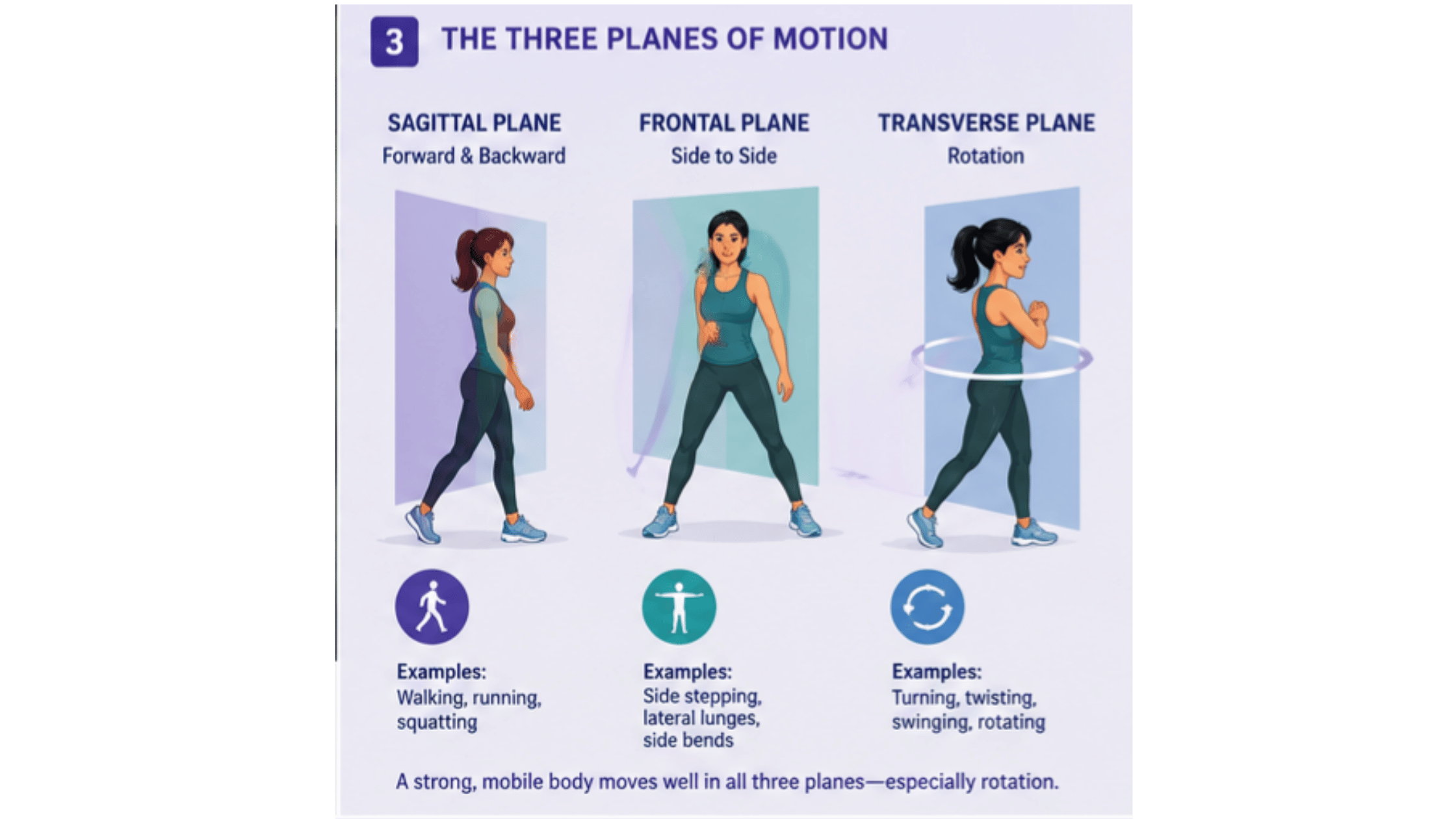
Much of modern life happens in front of us. We walk forward, drive forward, wash dishes facing forward, and sit at computers looking forward. So we tend to think about exercise and movement as forward and backward—walking, running, climbing stairs, standing up from a chair. Movement specialists call this the sagittal plane (the vertical slice that divides the left half of your body from the right). It gets most of the attention.
But daily life requires us to move forward and backward, side-to-side, and rotationally. We step sideways to avoid obstacles. We reach across our bodies to grab a seatbelt. We pivot when changing direction. We turn to see what’s happening around us.
Golf provides a vivid example, but you don't have to be a golfer to appreciate the lesson. A golf swing is a full-body rotational movement involving the feet, hips, spine, shoulders, and arms working in sequence. When mobility is limited in one area, another compensates—and that compensation often shows up as discomfort or injury elsewhere. A stiff thoracic spine may place more stress on the lower back. Limited hip rotation can alter mechanics all the way to the neck.
Human bodies are designed to turn, pivot, reach, and rotate. The challenge is that modern life gives us fewer opportunities to do so.
Twisting as a Tool for Daily Independence
In sports science, rotational movement happens in the transverse plane (the horizontal slice that divides your top half from your bottom half).
Almost every critical Activity of Daily Living (ADL) requires your body to twist. Think about the hidden rotation required to navigate a normal day:
Driving safely: Turning your head to check your mirrors, twisting your upper body to look over your shoulder, and pivoting your neck to catch a fast-moving vehicle in your blind spot.
Managing groceries: Reaching across your body to lift a heavy gallon of milk out of the shopping cart, or twisting from the counter to load a bulky package into the pantry.
Household chores: Sweeping under a couch, mopping, or pivoting to hand a heavy dish to someone standing behind you.
Pet and family care: Bending down and twisting to leash a wiggly dog, or turning quickly to catch a grandchild running past your chair.
Basic self-care: Reaching behind your shoulder to wash your back in the shower, or twisting to take off a stiff winter jacket.
When we lose the ability to twist easily, these simple tasks become frustrating, exhausting, or even hazardous. If your torso won’t rotate to check your blind spot, you’re forced to twist your entire hip and leg just to see—a clumsy compensation that drastically delays your reaction time on the road.
Why Twisting and Turning Become More Difficult
The ability to rotate depends on several regions of the body working together. Understanding which areas are involved—and why they tend to become stiff—helps make the case for why maintaining this movement matters so much.
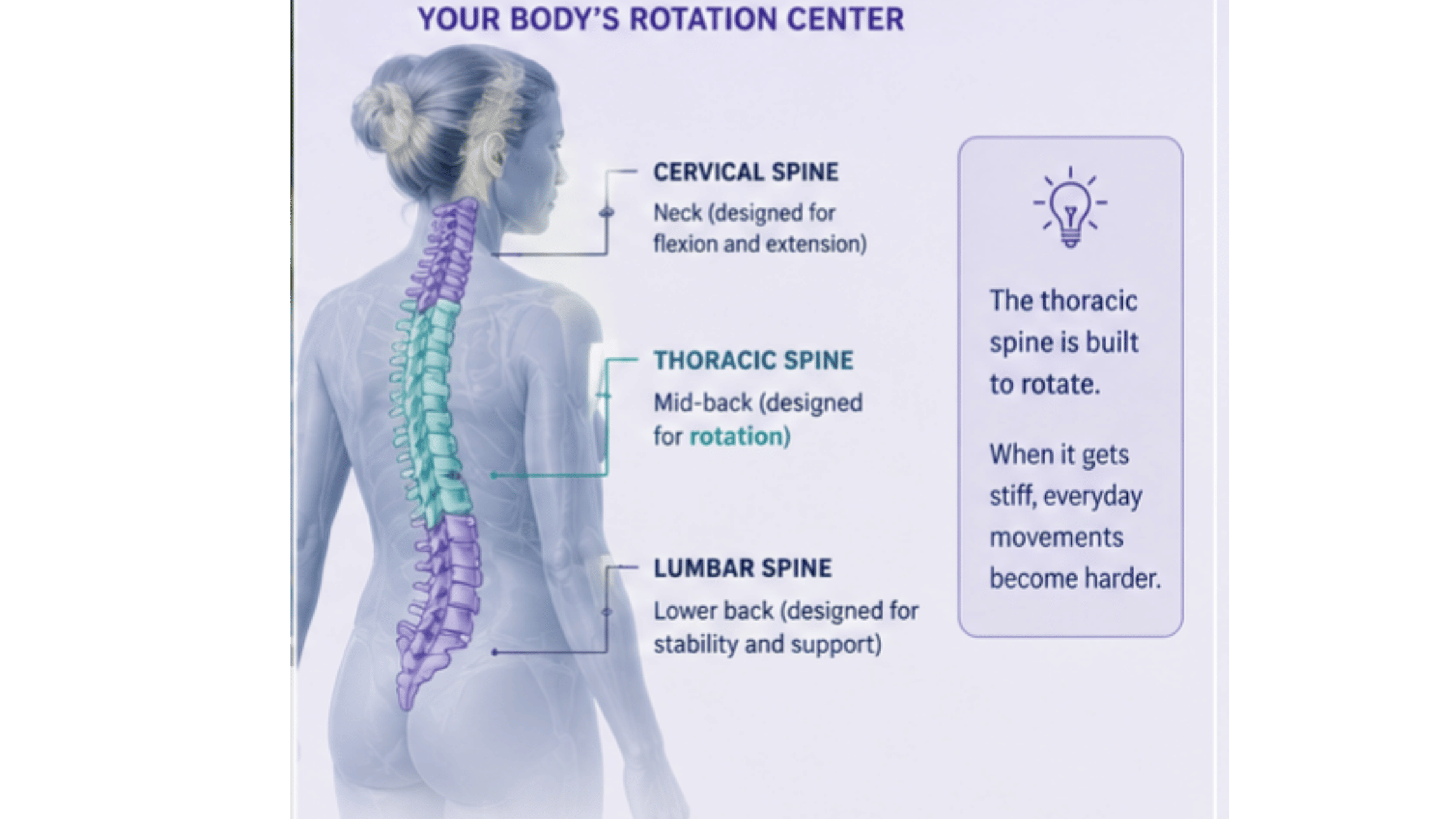
1. The Thoracic Spine (Mid-Back)
The thoracic spine is the primary rotational region of your entire spine. Yet, it’s often the area most undermined by modern habits. Hours of sitting and driving hold the mid-back in a sustained, rounded position. Over time, this gradually locks up the very region designed to help us turn.
What the Research Says: Thoracic spine mobility measurably declines with age, with the most significant losses appearing after age 60. A study tracking spinal range of motion found that fundamental spinal flexion can decline by nearly 50% over three decades—and rotational losses follow a similarly steep pattern.
There’s also a cascade effect: when the mid-back stiffens, the neck and lower back are forced to overcompensate. This extra stress is often the real culprit behind the chronic aches people falsely attribute to “just getting older.”
2. The Hips
The hips are frequently the missing piece in rotational decline. When hip rotation diminishes, the body reaches upward to the lower back to force a twist that the lumbar spine isn’t built to handle.
What the Research Says: A 2021 study followed older adults with chronic low back pain for 12 months and found that poor hip range of motion directly predicted declines in daily physical function—completely independent of age, body weight, or baseline pain levels Furthermore, a 2024 systematic review found that as pelvic rotation decreased, stride length shortened, forcing the mid-back to over-rotate to compensate.
3. The Cervical Spine (Neck)
The neck is where rotational decline often becomes most visible in daily life. Checking a blind spot or turning toward a friend speaking to you are ordinary movements—yet cervical rotation declines predictably over time if neglected.
What the Research Says: Research published in Aging Clinical and Experimental Research found that older adults demonstrate less accurate neck repositioning compared to younger adults. This means it’s not just range of motion that declines, but the nervous system’s ability to map where the head is in space. A subsequent 2022 study in Frontiers in Aging connected this reduced neck mobility to altered balance and decreased walking stability, linking neck health to fall risk.
The Muscles That Make It Happen
Rotation isn’t passive: it requires active, coordinated muscular strength. Your primary “twisting mechanics” include:
The Obliques (Internal and External): Your core’s main trunk rotators that pull your ribs and pelvis toward one another.
The Multifidus and Paraspinals: Deep, tiny stabilizers running along the vertebrae that control the quality of your spinal rotation and protect your discs.
The Piriformis and Deep Hip Rotators: A powerful group of six muscles deep in the glute region that govern which direction your leg bone twists inside the hip socket.
The Sternocleidomastoid (SCM) and Deep Cervical Rotators: The specialized muscles responsible for cleanly rotating your head and neck.
These muscles respond to use. When rotational movement disappears from daily life, they weaken and tighten, causing restricted and sometimes painful movement.
The Costs of Limited Rotation
The research on mobility and aging converges on a single, consistent theme: the physical abilities we actively maintain have a direct, measurable relationship to our independence, quality of life, and longevity.
Consider a prospective cohort study based out of Vancouver. Researchers tracked older adults over time and found that everyday mobility was the single most significant predictor of changes in health-related quality of life. Their conclusion was clear: “mobility is a critical factor to target for future intervention strategies aimed at maintaining or improving [quality of life] in late life.”
Why Rotation Matters More Than We Realize
When we lose our rotational capabilities, the stakes are high. Falls—which are often directly connected to a reduction in trunk mobility and rotational body awareness—represent one of the most significant threats to independence as we age.
This is why movement practices like Tai Chi are so effective. Because Tai Chi emphasizes slow, intentional trunk rotation, deliberate weight shifting, and highly coordinated turning, clinical research supports that it improves postural stability and balance more effectively than almost any other type of exercise for older individuals. It trains the brain and body to safely navigate the “twists and turns” of the real world.
Living Life Wide Open

While we absolutely need to maintain rotation to prevent these negative outcomes, what is even more important is preserving the ability to live our lives fully.
Think about the texture of a life well-lived. It is found in the fluid, unthinking moments:
Turning your head easily to hear a friend at a noisy restaurant.
Spinning and dancing at a family celebration.
Fluidly swinging a golf club or pickleball paddle.
Reaching around smoothly for an item on a high shelf.
These everyday moments depend entirely on a physical capability we rarely think about—until it begins to slip away.
The human body is an incredibly efficient machine. It tends to maintain the abilities we use regularly. The challenge is that it doesn’t distinguish between skills we’ve intentionally stopped using and skills we still need.
Your Regional Rotation Guide
🛑 Crucial Safety Guidelines: Know Your Boundaries
Before you begin exploring these movements, let’s establish two non-negotiable rules for safe mobility practice. Rotation is highly beneficial, but because our spinal discs and joints are sensitive to twisting, you must listen to your body’s signals.
The “No-Pain” Rule: Mobility work should feel like a gentle stretch, a release of tension, or mild muscular work. It should never cause sharp pain, pinching, radiating numbness, or electrical sensations. If a movement hurts, back out of it immediately.
Respect Your Asymmetry: You will likely find that you turn much more easily to one side than the other. This is completely normal. Don’t force your stiffer side to match your looser side. Meet each side exactly where it is today.
Move at “Strolling Speed”: Never ballistic-stretch or bounce into a twist. Sudden, jerky rotations trigger a protective reflex in your muscles that actually makes them tighten further. Slow, smooth, and breathing-controlled is the path to progress.
Keeping Yourself Twisting and Turning
Below is a streamlined, region-by-region guide with simple, targeted movements you can easily work into your week. You don’t need a gym, and you don’t even need to get down on the floor.
What you need is intention and consistency. Just two movements per area, a few times a week, can preserve the mobility you have and begin to reclaim what you’ve lost.
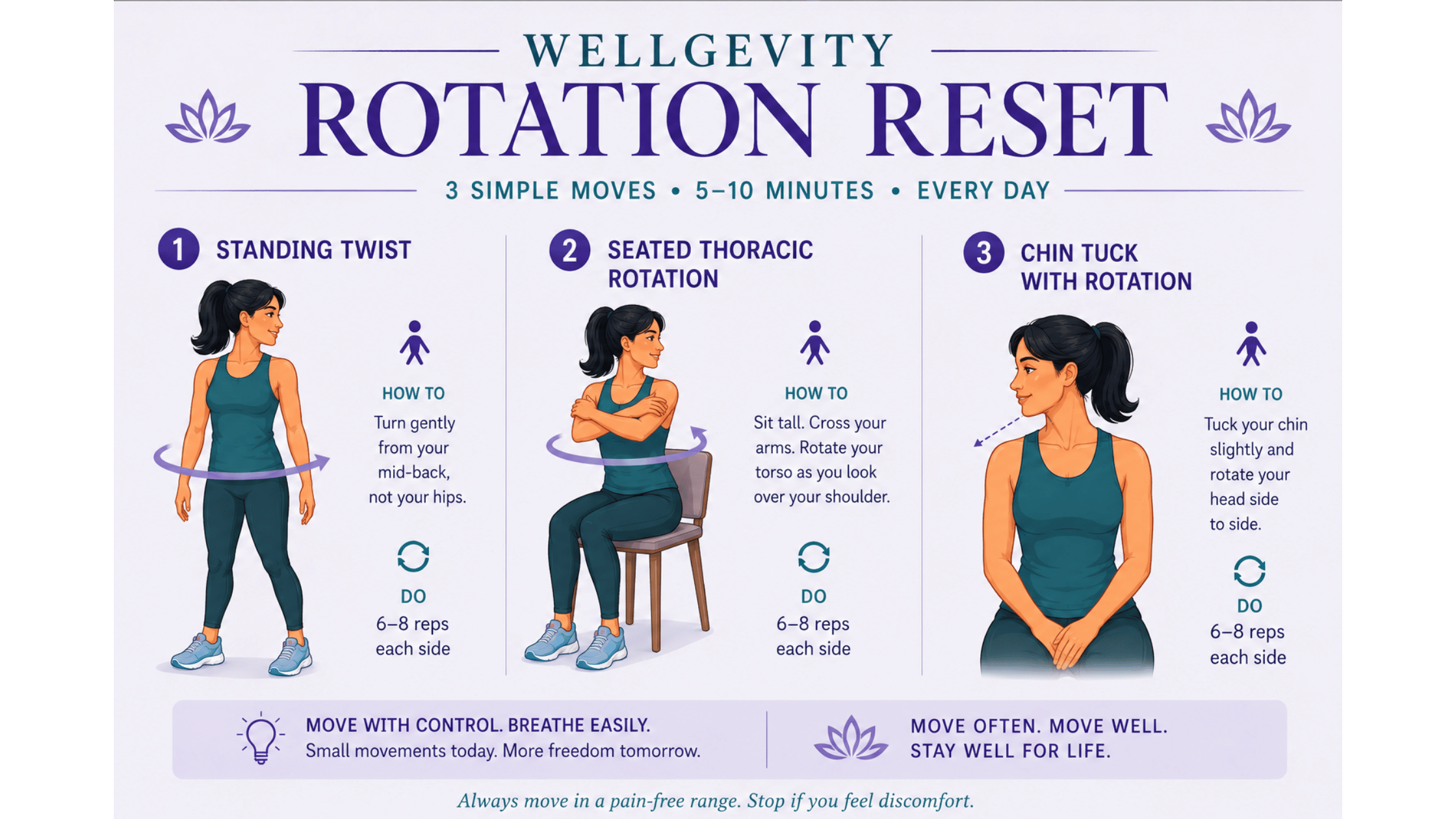
REGION 1: Muti-region
Standing rotation integrates the thoracic and lumbar spine with hip contribution. This functional pattern transfers directly to daily rotational demands and athletic movements.
1. Standing Twist
Stand with your feet about hip-width apart and your knees soft. Allow your arms to hang comfortably by your sides. Slowly rotate your torso to the right and then to the left, allowing your arms to swing naturally with the movement. Stay relaxed and move comfortably within your available range of motion. Continue for 30–60 seconds.
✔ Wellgevity Tip: Think of this as movement, not stretching. You’re reminding your body that rotation is a normal part of life. Smooth, easy movement is more important than how far you turn.
Region 2: The Thoracic Spine (Mid-Back)
The mid-back needs active encouragement to stay mobile. These movements target the thoracic vertebrae and rib cage directly, freeing up your upper body.
1. Seated Thoracic Rotation
How to do it: Sit tall at the edge of a sturdy chair with your feet flat on the floor. Cross your arms over your chest. Keeping your hips completely still, slowly rotate your upper body to the right as far as comfortable. Hold for 2–3 seconds. Return to center and repeat to the left. Perform 8–10 slow repetitions per side.
✔ Wellgevity Tip: Place a small pillow or a yoga block between your knees and squeeze it gently. This locks your hips in place, ensuring the twist happens in your mid-back where it belongs.
2. Standing Chair-Supported Rotation
How to do it: Stand facing the back of a sturdy chair or kitchen counter. Place your left hand firmly on the surface for balance. Take your right hand and place it behind your head. Inhale, and gently rotate your right elbow and chest up toward the ceiling, looking up with your eyes. Exhale and return to the start. Do 6–8 reps, then switch sides.
✔ Wellgevity Tip: This provides the same mid-back opening benefits as the floor-based “Thread the Needle” exercise, but keeps you safely on your feet while protecting your balance.
REGION 3: Hips and Pelvis
Hip rotation is often the first thing lost and the last thing addressed. These movements restore internal and external rotation—the foundational base for full-body turning.
1. Seated Hip “Windshield Wipers”
How to do it: Sit toward the front edge of a chair with your feet wider than shoulder-width apart, knees bent. Keeping your torso upright, slowly drop your right knee inward toward the midline of your body, pivoting slightly on your foot. Hold for 2 seconds, return to center, and drop the left knee inward. Do 8–10 alternating reps.
✔ Wellgevity Tip: This is the safe, accessible cousin to the aggressive floor 90/90 stretch. It coaxes internal hip rotation without pinching the joint or straining your lower back.
2. Standing Hip Swivels
How to do it: Stand with feet hip-width apart, hands lightly resting on a counter for safety, and your knees soft. Gently swivel your pelvis to draw large, smooth circles—5 clockwise, then 5 counter-clockwise. Follow this with 5 slow “figure-8” patterns.
✔ Wellgevity Tip: This is a fantastic, zero-equipment hip mobility movement you can do anywhere—while waiting for your morning coffee to brew or during a TV commercial break.
REGION 4: Neck and Cervical Spine
Your neck is where rotational decline impacts daily independence the most. These movements maintain range, control, and spatial awareness.
1. Chin Tucks with Rotation
How to do it: Sit or stand tall with your shoulders relaxed. Look straight ahead and gently glide your head straight back. Holding that tucked alignment, slowly turn your head to the right until you reach a gentle end range. Hold for 2 breaths, return to center, and repeat to the left. Do 6–8 reps per side.
✔ Wellgevity Tip: The subtle chin tuck aligns the vertebrae safely, taking the pinch and stress off the delicate joints at the base of your skull.
2. Visual-Tracked Rotation
How to do it: Sit comfortably with your head neutral. Extend your right thumb out in front of you at eye level. Slowly move your hand to the right in a wide arc, keeping your eyes locked onto your thumb as your head turns to follow it. Go to a comfortable end range, hold for 3 seconds, and slowly return. Repeat 5 times on each side.
✔ Wellgevity Tip: As the research noted, neck stiffness isn’t just muscular—it affects your brain’s spatial awareness. Tracking an object with your eyes while you turn retrains the nervous system and directly assists with your balance.
Important: The information in this article is intended for educational purposes only and is not a substitute for medical advice, diagnosis, or treatment. Consult your healthcare provider before beginning a new exercise or mobility program, especially if you have osteoporosis, a spinal condition, recent surgery, dizziness, balance concerns, or other medical conditions that may affect your ability to exercise safely.
Keep Giving Your Body a Reason to Rotate
When we continue to turn our heads, rotate our spines, pivot our hips, and move through all three planes of motion, our bodies receive a clear message that these skills still matter.
Twisting and turning may never appear on a standard list of fitness goals, but they influence how confidently we drive, garden, dance, play sports, perform household tasks, and navigate the world around us.
The good news is that preserving this Wellgevity Life Skill doesn’t require special equipment or hours in the gym. It starts by continuing to use it.
The body keeps what it needs. My goal is to keep giving my body reasons to turn, twist, and rotate. How about you?
As you think about your own ability to twist and turn, where do you notice it most in daily life?
P.S. If you've been thinking about how to stay active, capable, and engaged in the activities that matter most to you, that's exactly the kind of planning we'll be doing in my upcoming Ignite Your Summer workshop. To learn more click the button below. Wellgevity Warrior paid subscribers attend free with the discount code found in the Wellgevity Warrior Chat.
Great info. I play pickleball. Every split-step, every reach across my body, every pivot to track a dink. The game doesn't let you cheat it.
Daria, several years ago when I had trouble turning to the side while driving, I instantly got back in touch w.my PT. I learned exercises to undo the jangled nerves or muscles in my neck, and I've been good ever since. So important, our twist and turn abilities. I also do tai chi, and I think that helps immensely.